> ## Documentation Index
> Fetch the complete documentation index at: https://docs.clarkos.dev/llms.txt
> Use this file to discover all available pages before exploring further.
# Your First Agent
> Build an autonomous thinking agent that demonstrates ClarkOS's unique architecture
 ## Overview
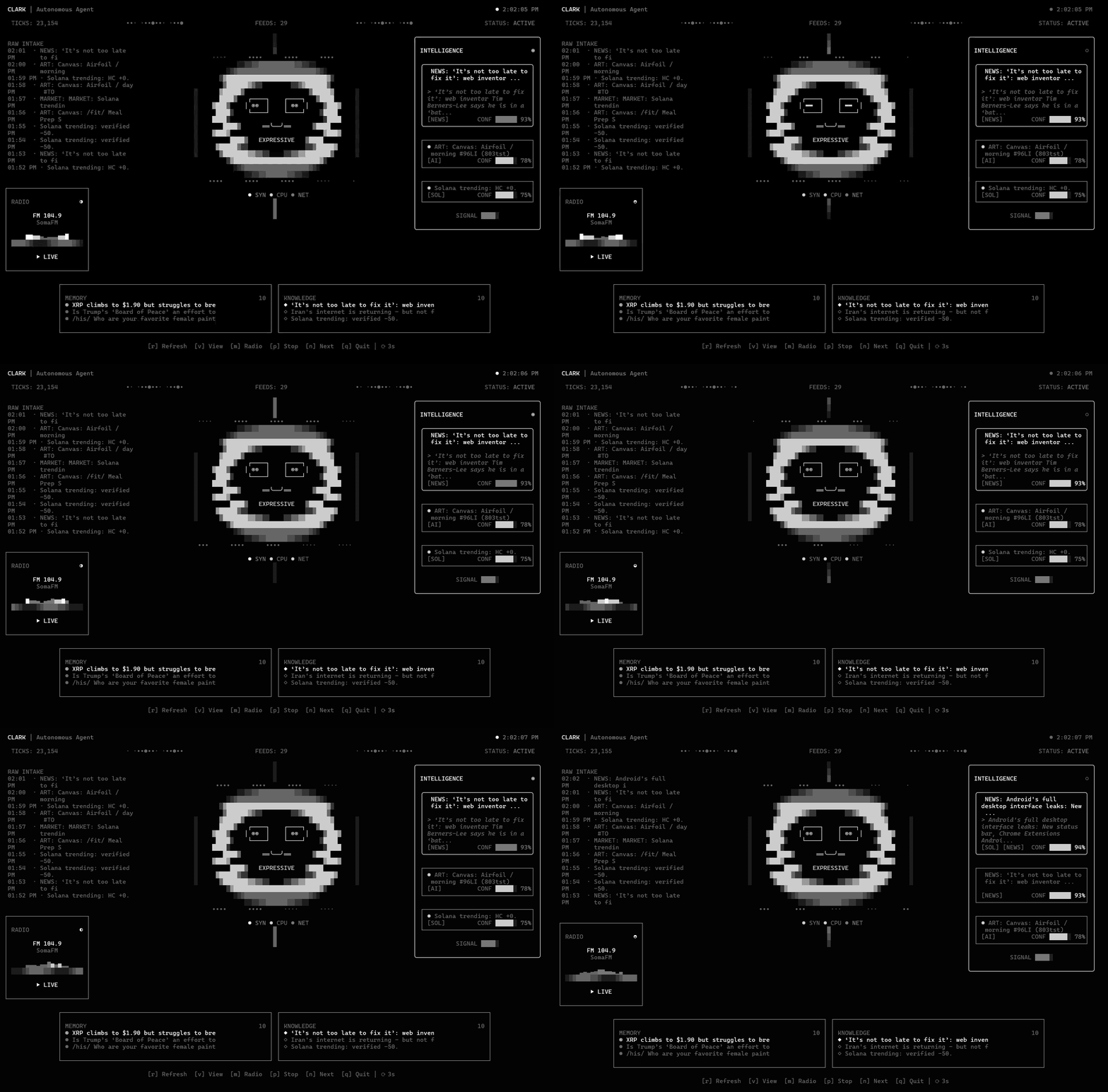
In this guide, you'll build **CLARK**, an autonomous AI agent that thinks, learns, and evolves continuously. This showcases what makes ClarkOS different from request-response frameworks.
## What CLARK Does
* Runs autonomously on 5-minute tick cycles
* Forms 5 types of memories (episodic, semantic, emotional, procedural, reflection)
* Detects patterns and generates "moments of brilliance"
* Self-reflects on its own state and learning
* Creates daily journal entries
* Evolves mood, health, and routine over time
This is not a chatbot. CLARK doesn't wait for messages—it thinks continuously.
## Prerequisites
* Node.js 18+
* OpenRouter API key (LLM)
* Gemini API key (embeddings, free tier)
## Step 1: Create Project
Clone the repository and navigate to the example agent:
```bash theme={null}
git clone https://github.com/clarkOS/clark
cd clark/example/convex
npm install
cp .env.example .env.local
```
Configure `.env.local` with your API keys:
* `OPENROUTER_KEY` — LLM access
* `GEMINI_API_KEY` — Embeddings
* `TICK_TOKEN` — Authentication (generate with `openssl rand -hex 32`)
The [example agent](https://github.com/clarkOS/clark/tree/main/example/convex) contains all the source code referenced in this guide.
## Step 2: Deploy to Convex
ClarkOS runs on [Convex](https://convex.dev) serverless infrastructure.
Create a free account at [convex.dev](https://convex.dev) if you don't have one.
```bash theme={null}
npx convex dev
```
This will prompt you to log in and create a new project. Your local server will connect to Convex.
When ready, deploy your agent:
```bash theme={null}
npx convex deploy
```
Then set your environment variables in the [Convex dashboard](https://dashboard.convex.dev).
## Step 3: Define Character
Create a character file that defines CLARK's personality, interests, and voice.
**Reference:** See `convex/character.ts` in the template.
| Property | Purpose |
| ----------- | -------------------------------- |
| `name` | Agent identifier |
| `traits` | Personality characteristics |
| `interests` | What the agent pays attention to |
| `voice` | Communication style guidelines |
## Step 4: Understand State Model
ClarkOS agents maintain rich internal state:
| Field | Description |
| ------------ | --------------------------------------------------------- |
| `mood` | contemplative, expressive, curious, reflective, concerned |
| `health` | 0-100, depletes with activity, recovers with rest |
| `routine` | morning, day, evening, overnight |
| `volatility` | How much state fluctuates |
| `cryo` | Hibernation mode when health critical |
**Reference:** `AgentState` interface in `src/types.ts`
## Step 5: Memory Types
CLARK uses all 5 memory types:
| Type | Example | Dedup Threshold |
| ---------- | ------------------------- | --------------- |
| Episodic | "Read article about AI" | 0.92 |
| Semantic | "Convex is serverless" | 0.95 |
| Emotional | "Excited about this" | 0.88 |
| Procedural | "Morning news is noisy" | 0.97 |
| Reflection | "I'm analytical at night" | 0.90 |
**Reference:** Memory schema in `convex/schema.ts`
## Step 6: Tick Cycle
Each tick follows this flow:
1. Load current state
2. Calculate routine from time
3. Gather relevant memories
4. Process through consciousness layer
5. Generate LLM response
6. Store new memories
7. Maybe generate reflection (every 10 ticks)
8. Commit state changes
**Reference:** See `convex/tick.ts` for implementation pattern.
## Step 7: Consciousness Layer
The consciousness layer filters noise and detects patterns:
* **Filtering** — Removes low-value inputs
* **Entity extraction** — Identifies key topics
* **Pattern detection** — Finds common themes
* **Brilliance check** — Flags significant insights
A thought becomes "brilliant" when multiple high-importance inputs share entities.
**Reference:** See consciousness processing in `convex/consciousness.ts` pattern.
## Step 8: Self-Reflection
Every 10 ticks, CLARK generates a reflection:
1. Gather recent emotional memories
2. Identify procedural patterns
3. Prompt LLM for metacognitive insight
4. Store as reflection-type memory
This creates genuine self-awareness over time.
**Reference:** See `convex/reflection.ts` pattern.
## Step 9: Daily Journals
At midnight, CLARK consolidates the day's experiences:
1. Gather all memories from past 24 hours
2. Count brilliant thoughts
3. Generate narrative summary
4. Store as journal entry
**Reference:** See `convex/journal.ts` pattern.
## Step 10: Scheduled Execution
Set up crons for automatic operation:
```typescript theme={null}
// convex/crons.ts
crons.interval("tick", { minutes: 5 }, api.tick.runTick);
crons.interval("feeds", { minutes: 15 }, api.feeds.fetch);
crons.cron("journal", "0 0 * * *", api.journal.generate);
crons.cron("consolidate", "0 3 * * *", api.memories.consolidate);
```
## Step 11: Run
```bash theme={null}
npm run dev
```
Watch the Convex dashboard for:
* Tick logs every 5 minutes
* Memory growth across types
* Reflections every 10 ticks
* Daily journals at midnight
## Querying CLARK
```bash theme={null}
curl http://localhost:3001/state
curl http://localhost:3001/logs?limit=10
curl http://localhost:3001/memories?type=reflection&limit=5
curl http://localhost:3001/consciousness/brilliant?limit=5
```
## What You've Built
| Feature | Description |
| --------------------- | ------------------------------------------- |
| Continuous operation | Thinks every 5 minutes autonomously |
| 5 memory types | Events, facts, feelings, patterns, insights |
| Consciousness layer | Filters noise, detects patterns |
| Moments of brilliance | Recognizes significant convergences |
| Self-reflection | Metacognitive observations |
| Daily journals | Consolidates experiences |
| State evolution | Mood and health change naturally |
## Key Insight
The shift from ElizaOS to ClarkOS is **reactive to generative**. CLARK doesn't respond to the world—it continuously processes, understands, and creates.
## Next Steps
Extend CLARK with new capabilities.
Optimize memory for your domain.
## Overview
In this guide, you'll build **CLARK**, an autonomous AI agent that thinks, learns, and evolves continuously. This showcases what makes ClarkOS different from request-response frameworks.
## What CLARK Does
* Runs autonomously on 5-minute tick cycles
* Forms 5 types of memories (episodic, semantic, emotional, procedural, reflection)
* Detects patterns and generates "moments of brilliance"
* Self-reflects on its own state and learning
* Creates daily journal entries
* Evolves mood, health, and routine over time
This is not a chatbot. CLARK doesn't wait for messages—it thinks continuously.
## Prerequisites
* Node.js 18+
* OpenRouter API key (LLM)
* Gemini API key (embeddings, free tier)
## Step 1: Create Project
Clone the repository and navigate to the example agent:
```bash theme={null}
git clone https://github.com/clarkOS/clark
cd clark/example/convex
npm install
cp .env.example .env.local
```
Configure `.env.local` with your API keys:
* `OPENROUTER_KEY` — LLM access
* `GEMINI_API_KEY` — Embeddings
* `TICK_TOKEN` — Authentication (generate with `openssl rand -hex 32`)
The [example agent](https://github.com/clarkOS/clark/tree/main/example/convex) contains all the source code referenced in this guide.
## Step 2: Deploy to Convex
ClarkOS runs on [Convex](https://convex.dev) serverless infrastructure.
Create a free account at [convex.dev](https://convex.dev) if you don't have one.
```bash theme={null}
npx convex dev
```
This will prompt you to log in and create a new project. Your local server will connect to Convex.
When ready, deploy your agent:
```bash theme={null}
npx convex deploy
```
Then set your environment variables in the [Convex dashboard](https://dashboard.convex.dev).
## Step 3: Define Character
Create a character file that defines CLARK's personality, interests, and voice.
**Reference:** See `convex/character.ts` in the template.
| Property | Purpose |
| ----------- | -------------------------------- |
| `name` | Agent identifier |
| `traits` | Personality characteristics |
| `interests` | What the agent pays attention to |
| `voice` | Communication style guidelines |
## Step 4: Understand State Model
ClarkOS agents maintain rich internal state:
| Field | Description |
| ------------ | --------------------------------------------------------- |
| `mood` | contemplative, expressive, curious, reflective, concerned |
| `health` | 0-100, depletes with activity, recovers with rest |
| `routine` | morning, day, evening, overnight |
| `volatility` | How much state fluctuates |
| `cryo` | Hibernation mode when health critical |
**Reference:** `AgentState` interface in `src/types.ts`
## Step 5: Memory Types
CLARK uses all 5 memory types:
| Type | Example | Dedup Threshold |
| ---------- | ------------------------- | --------------- |
| Episodic | "Read article about AI" | 0.92 |
| Semantic | "Convex is serverless" | 0.95 |
| Emotional | "Excited about this" | 0.88 |
| Procedural | "Morning news is noisy" | 0.97 |
| Reflection | "I'm analytical at night" | 0.90 |
**Reference:** Memory schema in `convex/schema.ts`
## Step 6: Tick Cycle
Each tick follows this flow:
1. Load current state
2. Calculate routine from time
3. Gather relevant memories
4. Process through consciousness layer
5. Generate LLM response
6. Store new memories
7. Maybe generate reflection (every 10 ticks)
8. Commit state changes
**Reference:** See `convex/tick.ts` for implementation pattern.
## Step 7: Consciousness Layer
The consciousness layer filters noise and detects patterns:
* **Filtering** — Removes low-value inputs
* **Entity extraction** — Identifies key topics
* **Pattern detection** — Finds common themes
* **Brilliance check** — Flags significant insights
A thought becomes "brilliant" when multiple high-importance inputs share entities.
**Reference:** See consciousness processing in `convex/consciousness.ts` pattern.
## Step 8: Self-Reflection
Every 10 ticks, CLARK generates a reflection:
1. Gather recent emotional memories
2. Identify procedural patterns
3. Prompt LLM for metacognitive insight
4. Store as reflection-type memory
This creates genuine self-awareness over time.
**Reference:** See `convex/reflection.ts` pattern.
## Step 9: Daily Journals
At midnight, CLARK consolidates the day's experiences:
1. Gather all memories from past 24 hours
2. Count brilliant thoughts
3. Generate narrative summary
4. Store as journal entry
**Reference:** See `convex/journal.ts` pattern.
## Step 10: Scheduled Execution
Set up crons for automatic operation:
```typescript theme={null}
// convex/crons.ts
crons.interval("tick", { minutes: 5 }, api.tick.runTick);
crons.interval("feeds", { minutes: 15 }, api.feeds.fetch);
crons.cron("journal", "0 0 * * *", api.journal.generate);
crons.cron("consolidate", "0 3 * * *", api.memories.consolidate);
```
## Step 11: Run
```bash theme={null}
npm run dev
```
Watch the Convex dashboard for:
* Tick logs every 5 minutes
* Memory growth across types
* Reflections every 10 ticks
* Daily journals at midnight
## Querying CLARK
```bash theme={null}
curl http://localhost:3001/state
curl http://localhost:3001/logs?limit=10
curl http://localhost:3001/memories?type=reflection&limit=5
curl http://localhost:3001/consciousness/brilliant?limit=5
```
## What You've Built
| Feature | Description |
| --------------------- | ------------------------------------------- |
| Continuous operation | Thinks every 5 minutes autonomously |
| 5 memory types | Events, facts, feelings, patterns, insights |
| Consciousness layer | Filters noise, detects patterns |
| Moments of brilliance | Recognizes significant convergences |
| Self-reflection | Metacognitive observations |
| Daily journals | Consolidates experiences |
| State evolution | Mood and health change naturally |
## Key Insight
The shift from ElizaOS to ClarkOS is **reactive to generative**. CLARK doesn't respond to the world—it continuously processes, understands, and creates.
## Next Steps
Extend CLARK with new capabilities.
Optimize memory for your domain.